Production
Clarify the thermal outcome and how operation varies.
HEAT TRANSFER / CLEANING / INTEGRATION
Thermal duty is only one part of the decision. Fouling, pressure drop, compatibility, and maintenance also shape the solution.
Copyable summary + LinkedIn, no direct submission. AI guidance is preliminary and requires your confirmation; do not include confidential information.
PROCESS STUDY / Industrial heat exchangers
Product
Operation
Integration
CONCEPTUAL DIAGRAM · DOES NOT REPRESENT REAL EQUIPMENT, SCALE, OR A SPECIFICATION.
Starting point
Prepare a basis for thermal and operational comparison without presupposing a technology or promising savings.
These are indicative contexts, not completed projects or performance claims for supplied equipment.
When to consider the solution
Compare alternatives based on the product, constraints, and acceptance criterion; the equipment name does not determine its suitability.
Information needed
Do not attach files or confidential information to the AI. Documentation is shared through an agreed channel, not automatically.
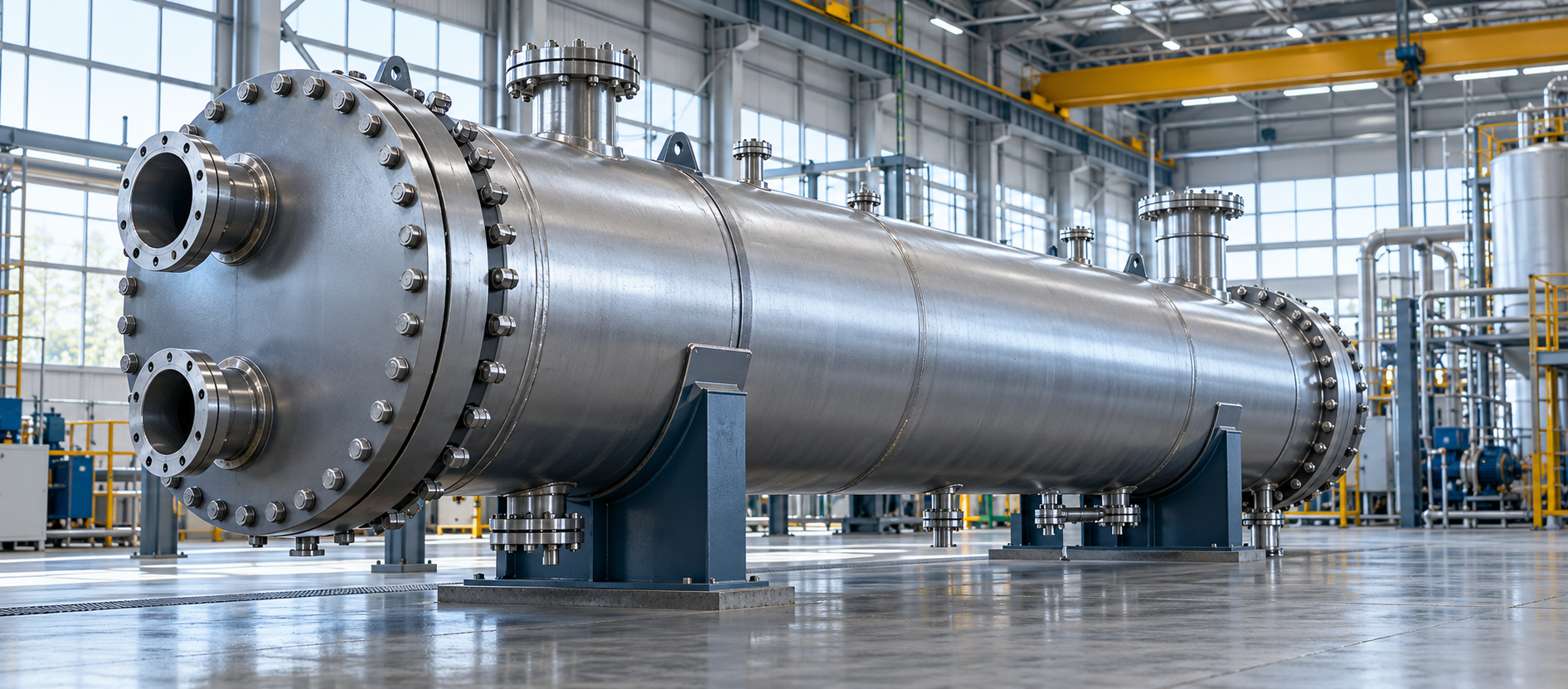
Visual context
The visual reference helps identify the equipment type, but the solution is defined by your product, conditions, and plant. Images are shown only as references, are not presented as our projects, and none replaces a technical assessment.
Evaluation basis
Share what you know and mark the rest as outstanding. Values, calculations, and applicable requirements must be verified by competent engineering professionals.
A shared decision
Clarify the thermal outcome and how operation varies.
Review calculations, cleaning, accessibility, and compatibility before choosing a technology.
Compare proposals under the same service conditions and acceptance criteria.
We help you organize the need, identify outstanding information, and prepare a technical discussion with a clear scope. VPENGINEERING does not present itself as a manufacturer: detailed design, manufacturing, and supply conditions require assessment and agreement by the relevant responsible parties.
See how we workCompare proposals
These questions do not constitute design or approval. Testing, certification, maintenance, and commissioning must be confirmed by the competent responsible parties; their availability is not assumed.
Scope and methodologyTechnical questions
Describe function, circuits and conditions without assuming a technology. Shell-and-tube and plate are distinct categories to assess; an ambiguous expression such as ‘tube and plate’ does not identify a type or establish its manufacture.
The choice depends on the fluids, service, cleaning, conditions, and constraints. There is no universal option, and it cannot be determined without process data.
Only with balances, actual conditions, and a comparison baseline. VPENGINEERING does not publish unverified savings or performance figures.
General information about the fluids, desired function, known flow rates and temperatures, available utilities, and issues with existing equipment, if any.
Your next step
The family will be selected in your inquiry. Fill in any information you want to prepare, copy the summary, and share it on LinkedIn. Nothing is sent automatically.
Prepare my technical summary